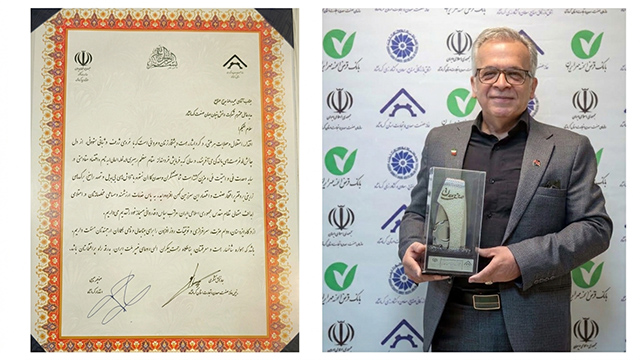
“The National Conference on Consumer Rights Protection was held in Kermanshah, honoring 23 top industrial and manufacturing units, including Jahan Foulad Gharb, Jahan Sanat, and Sima Foulad from the Shokri Industrial Group.”
“The second National Consumer Rights Protection Day Conference was held on Thursday, February 22, 2025, at the Modallal Cement Factory Conference Hall in Kermanshah. The event was organized by the Kermanshah Provincial Department of Industry, Mine and Trade, with the presence of Dr. Hossein Farhidzadeh, Deputy Minister of Industry, Mine and Trade and Head of the Consumer and Producer Protection Organization, Dr. Abdolvahid Mohammadi, Deputy Governor for Economic Affairs of Kermanshah Province, along with several executive managers and representatives of top-performing enterprises. During the ceremony, 23 leading industrial and manufacturing units of the province were
In this conference, 50 companies applied to receive the award for top performance. After a thorough review of their files by a committee composed of 14 executive organizations, 23 companies were selected as top-ranking units. These companies were recognized and honored for complying with required standards and demonstrating excellence in production and consumer rights protection.

In this conference, Mr. Jahandar Shokri, CEO of Bisotoun Steel Company, emphasized the direct relationship between production and consumption, and considered the role of producers crucial in improving product quality and reducing prices.
At the beginning of his speech, Mr. Shokri warmly welcomed the attendees, expressed his gratitude for the presence of Dr. Farhidzadeh, Dr. Mohammadi, Mr. Darabi, and other managers, and emphasized that this conference provides a valuable opportunity to explore strategies for supporting both consumers and producers.
He referred to the important role of producers in the country’s economy and said
If today is designated as Consumer Protection Day, it must be noted that every producer is also a consumer. These two concepts are inseparable and together form the core of any country’s economy. Production without consumption is meaningless, and if consumers do not have the purchasing power or access to quality goods at reasonable prices, producers will also face a crisis
The CEO of Bisotoun Steel, referring to the challenges facing the country’s manufacturing industries, identified three key factors as vital for supporting production and, consequently, supporting consumers:
1- Providing stable and guaranteed energy supply:
He explained that despite industrial electricity consumption in the province being only 60 megawatts, it still faces restrictions.
“If gas is supplied to Modallal Group next year and the power plant can operate, this issue will largely be resolved. Our group has invested over 10 trillion IRR to ensure energy supply.”
2- Obtaining low-interest financial facilities:
Mr. Shokri, referring to the high costs of financing and the high bank interest rates, stated that producers need affordable and low-interest facilities in order to maintain competitiveness and offer products at reasonable prices.
3-Eliminating administrative bureaucracy and adopting a positive approach toward production:
One of the major challenges for producers is administrative obstacles and complex bureaucratic processes.
The CEO of Bisotoun Steel, by providing an example from the steel production chain, explained how increasing production can reduce product prices.
“Currently, all products in the steel production chain, from iron ore and pellets to billets and steel sections, are traded on the commodity exchange. When production levels are high, prices in the market are controlled, and consumers can purchase goods at more reasonable prices. This happens when producers are able to increase their production without energy, financial, and administrative constraints.”
He emphasized that increasing production reduces the fixed costs of factories, which directly has a positive impact on the final prices of goods.
Mr. Shokri, continuing his speech, referred to the role of production units in Kermanshah in the economic development of the province and said:
“We are from Kermanshah and belong to this land. Our social duty is to produce in this province, create employment, and help improve the economic situation of the people. Today, Modall Industrial Group, Rojin-Tak Company, Bakhtar Cable, West Cement, and many other factories are operating beyond mere economic profitability—as a social responsibility.”
He emphasized that the primary goal of producers is to create added value and contribute to the country’s economy, not merely to make a profit.

He stressed the necessity of convergence and collaboration among producers, consumers, and the government, stating:
If we want to protect consumer rights, we must also support the producer. The stronger the domestic production, the better and more affordable goods consumers will have access to. This path is only possible through proper planning, reforming economic policies, and removing production barriers.”
MR. Shokri, in his speech, emphasized the importance of job creation and the role of industry in the livelihood of the people of Kermanshah, stating:
“We have the duty to continue production so that the people of the province—our fellow citizens, brothers, and sisters living in Kermanshah—can find employment in industrial units and jobs can be created.”
He pointed out that Kermanshah has unique industrial capacities, and the Supreme Leader has also introduced this province as the “Strong Chest of Iran.”
Mr. Shokri highlighted key industrial challenges in Kermanshah:
1) Energy shortages and electricity cuts:
He explained that despite industrial electricity consumption in the province being only 60 megawatts, it still faces restrictions.
“If gas is supplied to Modallal Group next year and the power plant can operate, this issue will largely be resolved. Our group has invested over 10 trillion IRR to ensure energy supply.”
He said:
“If gas is supplied to the Model Group next year and the power plant can provide its own electricity, the problem will largely be solved. We have invested over 100 billion tomans (approx. $2 billion) within our organization to secure the required energy. In fact, the electricity issue in Kermanshah’s industry has a significant impact on the province, but it is not a considerable figure at the national level.”
2) Access to low-interest financial facilities:
Another challenge highlighted by this industrial expert was the rising production costs in recent years. He stated that manufacturers are forced to purchase raw materials at higher prices, which leads to an increase in the overall cost of products.
When raw materials become more expensive, production costs increase by 25%. On the other hand, transportation fees have also risen by 30%. How are we supposed to compensate for these costs?
Mr. Shokri also identified tax issues and complex tax regulations as other major challenges facing producers and said:
We have already paid taxes and value-added tax, but after a few months, we face new calculations applied retroactively. How are we supposed to manage these additional costs?
3) Problems in Procuring Industrial Equipment
This industry expert also pointed out the challenges in procuring industrial parts and equipment, stating that due to market fluctuations and currency issues, the necessary parts for industries have become scarce within the country.
He said:
“Currently, some factories in Kermanshah are operating at only 40% of their capacity. Power outages and lack of equipment have caused production lines to stop. The steel industry cannot be easily turned off and on. If a steel plant shuts down, it takes 24 to 48 hours to restart. This issue causes heavy losses for producers.

Mr. Shokri emphasized that to solve the problems of the industry in Kermanshah, more authority must be granted to provincial managers. He said in this regard:
We must grant more authority to provincial managers in the province so they can make decisions to solve problems. Not everything can be managed from Tehran. When a production unit in Kermanshah faces an issue, provincial officials must be able to make quick decisions and resolve the problem
He also requested that the authorities show more patience and tolerance when collecting payments related to electricity, gas, and taxes.
The country’s economic situation is not normal. If we have mutual understanding of the challenges and cooperate, we can overcome this crisis. However, if producers are put under pressure, industrial units will shut down, which will directly lead to unemployment and economic recession.
At the end of his speech, Mr. Jahandar Shokri proudly mentioned Kermanshah and said:
Iran is my homeland, but Kermanshah is my city. We, the people of Kermanshah, have always stood by our city and will continue to do so. Many of the major industries in Kermanshah are now recognized worldwide, and prominent brands operate here. We hope that with greater support, we can expand production and keep the flag of Kermanshah flying high on the global stage
At the continuation of the ceremony, Hossein Farhidzadeh, Deputy Minister of Industry, Mine and Trade (IMT) and Head of the Organization for Support of Producer and Consumer, emphasized at the National Consumer Rights Support Day conference that supporting the consumer is, in fact, supporting the producer. He stated that if suitable conditions are provided for producers, it will be possible to offer goods and services to consumers with appropriate prices and quality.
Farhidzadeh, referring to the serious problems in the production sector, especially energy imbalance, stated that the industry and production in the country suffer a daily loss of 1 trillion tomans (approximately 20 billion USD) . He emphasized that this situation not only imposes heavy financial damage on producers but also causes harm to industrial machinery, resulting in reduced quality and increased prices of goods.
He also pointed to other production challenges, including financial imbalances, and said: “What can be done to support production is precise planning, avoiding sudden decisions, and ensuring the supply of raw materials and essential goods for this sector.”
The Deputy Minister of Industry, Mines, and Trade emphasized that the approach of the Organization for Support of Producers and Consumers is to supervise and support both sectors, and the organization does not aim to catch producers in faults or impose unnecessary restrictions on them.
Also, Dr. Abdolvahid Mohammadi, the Deputy of Economic Affairs of the Governorate, emphasized the key role of producers and industrialists as the frontline warriors (jihadists) in the field of the economy during this conference.
He highlighted the importance of supporting domestic products, considering this approach an effective factor in reducing inflation rates and increasing national production.
The deputy governor also emphasized that the economic challenges of provinces are not uniform across the country, and each region requires tailored solutions suited to its specific conditions.
In conclusion, he stressed the necessity of fostering a culture of work and entrepreneurship from early ages and emphasized the importance of incorporating these teachings into the national education system.
Mr. Darabi, Director General of Industry, Mining, and Trade of Kermanshah Province, emphasized the importance of protecting consumer rights at the conference and stated:
“Protecting consumer rights is not limited to preventing underweight or overpriced sales; it must be considered throughout the entire supply chain up to distribution.”
He identified after-sales services, timely supply of goods, adequate quality, and fair pricing as the most important criteria for supporting consumer rights.
Mr. Darabi, referring to the selection process of top production and service units, stated:
“This process began earlier this year based on the criteria of the Consumer Protection Organization. After evaluations conducted by a technical committee composed of 14 executive bodies, 23 top production and service units were introduced as supporters of consumer rights.
He congratulated the National Consumer Rights Protection Day (February 28th) and announced the presence of Dr. Farhidzadeh at this gathering. He emphasized that during the ceremony, producers who support the consumer rights in the province were honored.
The Director General of Industry, Mining, and Trade of Kermanshah continued by addressing the challenges in the production sector, stating:
“Our producers face numerous limitations and difficulties. While they should be focusing on producing goods and services, they are forced to generate energy and establish power plants, and even face problems in supplying fuel for these power plants.”
He added,
“Despite these challenges, I have faith that these producers are the steadfast warriors in the field of production and trade of the country and, as always, will emerge victorious from this trial.”

At the conclusion of the ceremony, exemplary consumer-supporting units were honored with certificates of compliance with consumer rights. Among the recipients of these certificates were:
Jahan Foulad Gharb, Sima Foulad Jahan, Jahan Sanat, Medal Cement, Praman Company, Shadram Shimi, Pasteurized Milk and Dairy of Bisotoun, Zagrosian Ghal‘eh Shahin Company, Rojin Tomato Paste Company, Khoshe Gandom Company, Adib Kermanshahi Oil, Maleki Cold Storage, Cement Gharb, Chareh Jo Concrete Factory, Shekar Riz Company, and others.
Public Relations Department of Shokri Industrial Group